What is Chaos ransomware?
Chaos is a cyber extortion group that compromises corporate networks, steals sensitive data and encrypts systems. Victims are listed on a leak portal where samples of stolen information are published to increase pressure.

24/7 incident response by senior DFIR experts. If you suspect a Chaos ransomware intrusion, contact us now – we help you stabilise the situation quickly.
Chaos is a ransomware group that runs a public data leak site and has claimed dozens of victims worldwide, with a focus on technology, financial services, logistics, construction and manufacturing. Attacks typically involve system encryption, data theft and pressure via staged data releases.
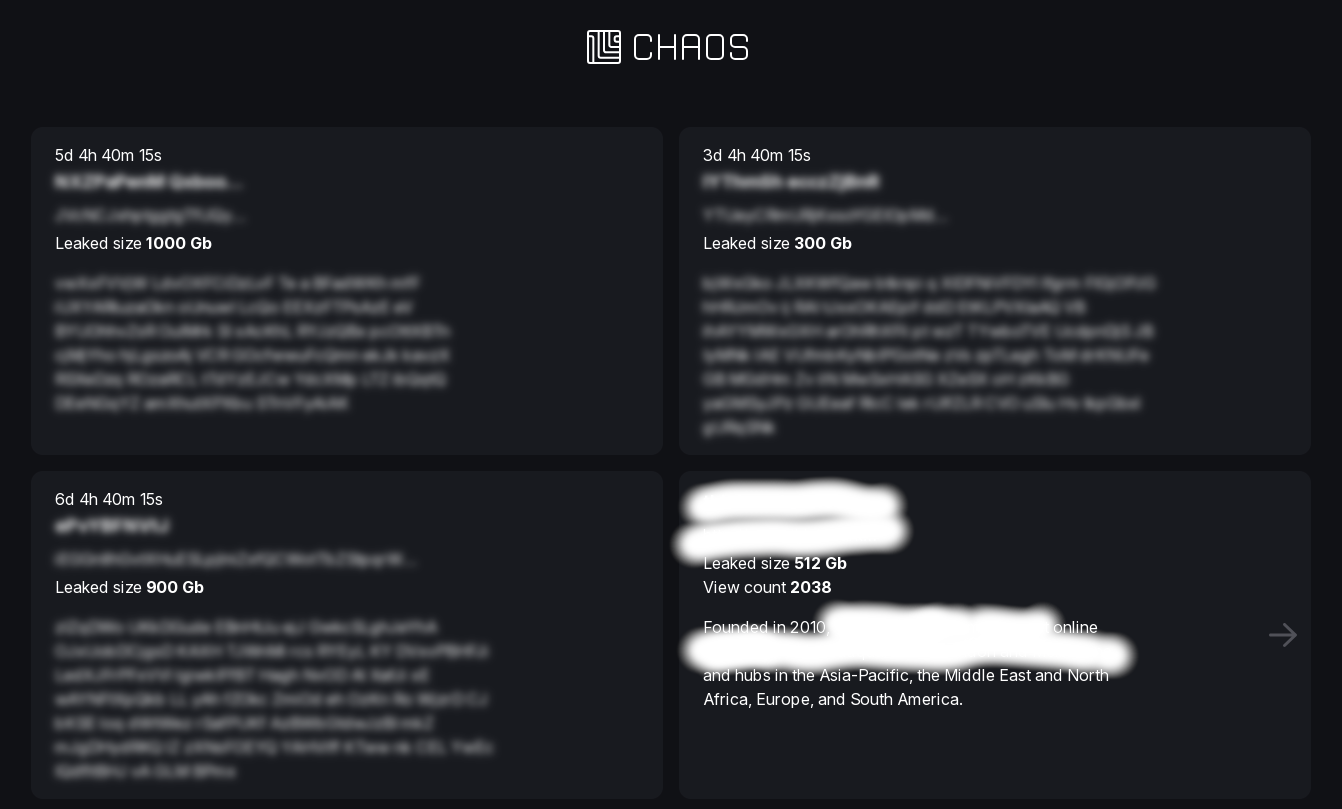
Example of a ransomware leak site used to publish stolen data (illustrative; customer data anonymised).
Chaos is a cyber extortion group that compromises corporate networks, steals sensitive data and encrypts systems. Victims are listed on a leak portal where samples of stolen information are published to increase pressure.
Victims span a broad range of sectors – from cloud and software providers to logistics operators, construction firms and manufacturers. Many targets provide critical services or handle high volumes of personal or financial data.
Even a single successful attack can cause weeks of disruption, regulatory scrutiny, contractual penalties and reputational damage. Chaos leverages staged data leaks and threats of public exposure to push for payment.
Public sources suggest that Chaos is still evolving. Tactics, infrastructure and tooling may change over time, so keeping detection logic up to date is essential.
Many victims operate complex IT/OT environments or supply-chain critical services, making them attractive targets for disruptive ransomware attacks.
The following IOCs have been associated with Chaos campaigns in public reporting. They should be treated as starting points for threat hunting – not as exhaustive or solely reliable detection mechanisms.
144.172.103.4245.61.134.36107.170.35.225These addresses have been observed in connection with Chaos infrastructure. They may change quickly – always combine with current threat intelligence.
Example hashes linked to Chaos binaries or loaders in public IOCs:
MD5:
  160f60dc3fc9920cfc3847de4de2ef09
  9113f4b245da32c75d61b467ee89e0b7
  87fd821b67a1f329548f222d81a55be7

SHA-256:
  7c4b465159e1c7dbbe67f0eeb3f58de1caba293999a49843a0818480f05be14e
  11cfea4100ba3731d859148d2011c7225d337db22797f7e111c0f2876e986490
  1d846592ffcc19ed03a34316520aa31369218a88afa4e17ac547686d0348aa5b
Always verify hashes against your own feeds and detection platforms. Over time, Chaos actors may rotate payloads and obfuscation techniques.
Exact TTPs vary between incidents, but Chaos operations largely follow a “classic” playbook used by many enterprise ransomware groups:
T1078 Valid Accounts, T1133 External Remote Services (VPN, RDP, remote access tools)T1059 Command & Scripting Interpreter (PowerShell, cmd.exe)T1547 Boot or Logon Autostart Execution (services, scheduled tasks)T1068 Exploitation for Privilege EscalationT1562 Impair Defenses (AV/EDR tampering, log clearing)T1003 OS Credential DumpingT1087 Account Discovery, T1018 Remote System DiscoveryT1021 Remote Services (RDP/SMB/WinRM)T1119 Automated Collection, T1041 Exfiltration Over C2 ChannelT1486 Data Encrypted for Impact, T1490 Inhibit System RecoveryFor real-world cases we map observed events to ATT&CK techniques to structure detection engineering, reporting and lessons learned.
The first three days of a Chaos ransomware incident are crucial. Our established playbook helps you regain control, keep stakeholders informed and prepare for safe recovery.
Hour 0–4
Rapid triage & containment
Scope the incident, stabilise key systems and guide you through safe isolation steps while preserving evidence for later analysis.
Hour 4–24
Forensic acquisition & attacker reconstruction
Acquire logs, endpoint data and key system images. Reconstruct the attacker timeline, including initial access, lateral movement and exfiltration.
Day 2–3
Recovery planning & decision support
Develop a phased recovery plan, including options with and without decryption, and provide input for executive, legal and communications decisions.
Many organisations contact us when they have already received a ransom note or seen their name on a Chaos leak site. Even in these situations, structured external support can make a significant difference.
Chaos uses a classic double-extortion model: in most cases both encryption and data theft are involved. Some victims are listed on the leak site even when operations have partially recovered, to maintain pressure.
In many incidents, recovery from backups and reinstallation is technically possible. The key questions are: how much data has been exfiltrated, how robust are your backups, and what regulatory or contractual obligations apply.
Communication should be aligned with the technical facts: what was accessed, what was encrypted, what is known and what is still under investigation. We work closely with legal and PR teams to support consistent, fact-based messaging.
Yes. We regularly work alongside cyber insurance providers and law firms. Our role is to provide a defensible technical picture and support risk-based decisions around recovery and potential negotiations.
As a specialised DFIR team, we support organisations through all phases of a Chaos ransomware incident – from first triage to secure rebuild:
On request, we provide lightweight checklists for Chaos-style ransomware readiness (identity security, backups, detection coverage, incident exercises) that your team can use internally.